News1

10 CubeSats to be loaded onto the 5th launch of Nuri
From monitoring fine dust and marine debris to space radiation and optical communication
[Seoul = News1] Reporter Na Yeon-jun = Artificial intelligence (AI) will assess the growth status of pharmaceutical crystals in space, while SK Hynix’s DRAM will be tested to see if it can withstand the harsh space environment. Additional missions include monitoring fine dust and marine debris, as well as attempting laser optical communications between satellites and the ground.
These are the missions to be carried out by 10 CubeSats loaded onto the 5th launch of South Korea's space launch vehicle, Nuri, scheduled for October 7.
According to the Korea AeroSpace Administration (KASA) and the Korea Aerospace Research Institute (KARI) on the 15th, the 5th launch of Nuri will carry five "NeonSat" microsatellites as primary payloads, alongside 10 CubeSats developed by domestic corporations, universities, local governments, and research institutes as secondary payloads.
Each of the 10 CubeSats will perform distinct missions ranging from space environment and Earth observation to biotechnology, AI, and the verification of semiconductors and satellite components.
(Provided by the Korea AeroSpace Administration)
AI Judges Pharmaceutical Crystal Growth in Space... Domestic Semiconductor Performance Verification
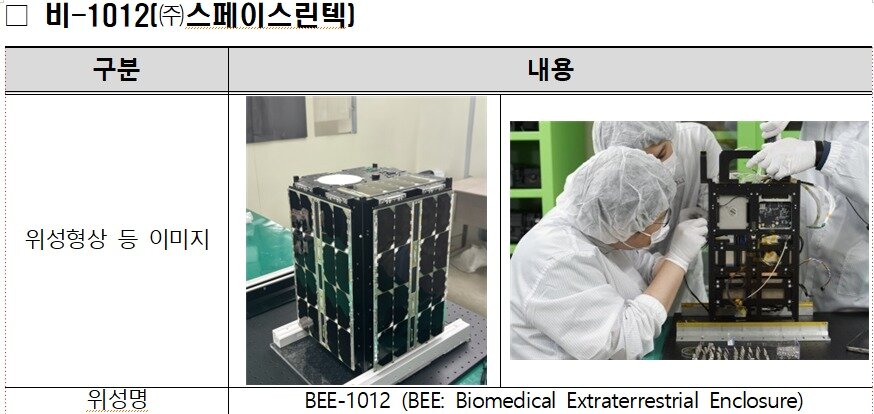
The 12U (1U = 10cm × 10cm × 10cm) class CubeSat "BEE-1012," developed by Space Linetech, will conduct pharmaceutical crystal growth experiments in space.
It is equipped with a chamber that grows pharmaceutical crystals in the microgravity environment of low Earth orbit (LEO) and a low-power on-board AI computing unit. The AI directly judges the generation and growth stages of crystals in orbit and adjusts experimental conditions accordingly.
Because low Earth orbit satellites have limited communication windows with ground stations, real-time experimental assessment from the ground is difficult. BEE-1012 uses AI to analyze generated data directly in orbit and transmit only meaningful data back to the ground. It also plays a role in detecting satellite anomalies, malfunctions, or warning signs.
Through this demonstration, the project aims to secure flight heritage for autonomous AI operation technologies and establish a foundation for microgravity experimental services that domestic pharmaceutical and biotech companies can utilize in the future.
Domestic semiconductors and space components, including SK Hynix’s DRAM, will also undergo performance verification in actual space environments.
The "Domestic Device and Component Space Verification Platform 2" (E3 Tester-2), developed by KARI, carries six types of locally developed components, including SK Hynix’s DRAM and Universal Flash Storage (UFS).
Also heading into space are high-speed precision steering mirrors, reaction wheels, attitude determination system modules, hollow cathodes for electric thrusters, and orbit transfer vehicle avionics testbeds.
These components will be exposed to actual thermal and radiation environments in space to check functional characteristics, error rates, and performance degradation. The goal is to secure actual space flight heritage to help expand market channels for domestic space components.
Lee Jae-ho, CEO of the Unmanned Exploration Laboratory. (Provided by the Korea AeroSpace Administration)
Observing Fine Dust and Marine Debris... Communicating with Earth via Laser
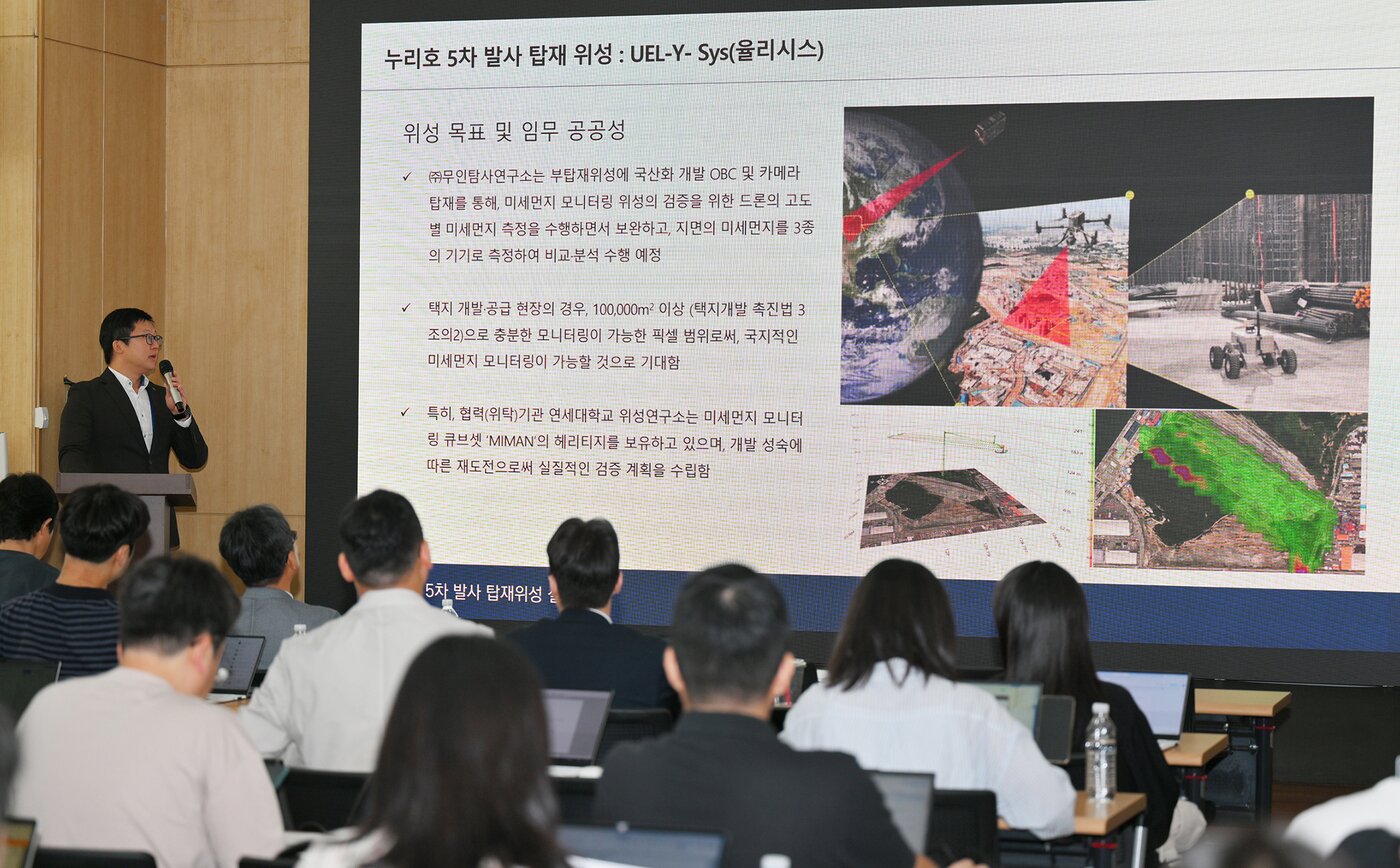
CubeSats designed to observe the Earth's environment are also heading to space. Unmanned Exploration Laboratory’s "UEL-Y-Sys" will observe the movement and generation sources of fine dust. Simultaneously, it will pre-verify the onboard computer (OBC) intended for future lunar exploration rovers and test the functionality of domestic components such as satellite attitude control, communication, power, and batteries.
Quaternion’s "PERSAT02" will detect dense areas of floating debris in the waters off Jeju Island and the southern coast, analyzing movement trends in connection with ocean currents and winds. It will also verify the in-orbit performance of domestic components, including the satellite structure, onboard computer, and power system.
ONB Space’s "SLEDGE" will observe atmospheric data such as temperature, humidity, and pressure by utilizing the phenomenon where Global Navigation Satellite System (GNSS) signals are refracted as they pass through Earth's atmosphere. It aims to collect 6,000 cases of near-real-time weather data daily by operating a constellation of over 50 CubeSats in the future.
The Korea Advanced Institute of Science and Technology's (KAIST) "GBSAT" will collect space radiation environment data by observing high-energy protons in low Earth orbit. The GBSAT team consists of five university students who graduated from the same high school, selected through a CubeSats competition hosted by KARI.
Space & Bean’s "SD-1 SAT" will collect radiation data from the South Atlantic Anomaly (SAA) while testing whether commercial ground components—such as edge AI and IoT communication modules—operate normally in space.
Chosun University’s "CPSat" will test laser optical communication technology between satellites and the ground. Using a 1550㎚ band optical communication payload, it aims to transmit optical signals from orbit to the ground and verify communication performance linked with ground optical systems. The goal is to secure high-speed, high-capacity communication technology that can supplement traditional radio frequency (RF) communications amid a surge in satellite-generated data.
Additionally, Daejeon City's "DaejeonSat-1" will observe urban spatial changes using a 1.5-meter-class electro-optical camera while verifying space components developed by local companies. It will also feature a "selfie camera," a first for a domestic satellite, to photograph the satellite itself. CosmoWorks' "JACK-007" will load an optical telescope onto a 3U-class CubeSat to acquire Earth observation imagery and verify indigenous satellite manufacturing and operation technologies.
The 10 CubeSats will be deployed into orbit after Nuri separates all five primary payload NeonSats. Nuri is scheduled to eject the CubeSats two at a time at intervals of approximately 10 seconds, across a total of five sequences.
What specific aspect of these 10 experimental payloads interests you the most?
yjra@news1.kr
——————————————————————————
누리호 5차 발사에 큐브위성 10기도 탑재
미세먼지·해양쓰레기 관측부터 우주방사선·광통신까지
누리호 5차 발사에 탑재되는 10기 큐브위성 관련 관계자.(우주항공청 제공)
(서울=뉴스1) 나연준 기자 = 인공지능(AI)이 우주에서 의약품 결정의 성장 상태를 판단하고, SK하이닉스의 D램(DRAM)이 혹독한 우주 환경을 견딜 수 있는지 시험한다. 미세먼지와 해양쓰레기를 관측하고 위성과 지상 사이 레이저 광통신에도 도전한다.
오는 10월 7일 발사되는 한국형 발사체 누리호 5차에 실리는 10기의 큐브위성이 수행할 임무다.
15일 우주항공청과 한국항공우주연구원에 따르면 누리호 5차에는 주탑재위성인 초소형군집위성 '네온샛' 5기와 함께 국내 기업과 대학, 지방자치단체, 연구기관 등이 개발한 큐브위성 10기가 부탑재위성으로 실린다.
10기의 큐브위성은 각각 우주 환경·지구 관측부터 바이오·AI, 반도체와 위성 부품 검증까지 서로 다른 임무를 수행한다.
AI가 우주서 의약품 결정 성장 판단…국산 반도체 성능 검증도
스페이스린텍이 개발한 12U(1U=10㎝×10㎝×10㎝) 규격급 큐브위성 '비-1012'(BEE-1012)는 우주에서 의약품 결정 성장 실험을 수행한다.
저궤도의 미세중력 환경에서 의약품 결정을 성장시키는 체임버와 저전력 온보드 AI 연산장치를 탑재했다. AI가 궤도에서 결정의 생성 여부와 성장 단계를 직접 판단하고 그 결과에 따라 실험 조건을 조정한다.
저궤도 위성은 지상국과 교신할 수 있는 시간이 제한돼 지상에서 실시간으로 실험 상황을 판단하기 어렵다. BEE-1012는 AI를 활용해 궤도에서 생성되는 데이터를 직접 분석하고 의미 있는 데이터만 선별해 지상으로 전송한다. 위성의 이상이나 고장, 위험 징후를 감지하는 역할도 맡는다.
이번 실증을 통해 AI 자율운용 기술의 비행 이력을 확보하고 향후 국내 제약·바이오 기업이 활용할 수 있는 미세중력 실험 서비스 기반을 마련한다는 계획이다.
SK하이닉스의 D램 등 국산 반도체와 우주 부품도 실제 우주 환경에서 성능 검증에 나선다.
항우연이 개발한 '국산소자부품 우주검증 플랫폼 2호'(E3 Tester-2)에는 SK하이닉스의 D램과 범용플래시저장장치(UFS)를 비롯해 국내에서 개발한 6종의 소자·부품이 탑재된다.
고속·정밀조정거울, 반작용휠, 자세결정 시스템 모듈, 전기추력기용 할로우음극, 궤도 수송선 항전 장비 테스트베드 등도 함께 우주로 향한다.
이들 부품을 실제 우주의 열과 방사선 환경에 노출해 기능 특성과 오류율, 성능 저하 등을 확인한다. 우주에서 실제 사용한 이른바 '우주 헤리티지'를 확보해 국산 우주 부품의 판로 확대에도 활용한다는 구상이다.
미세먼지·해양쓰레기 보고…레이저로 지상과 통신
지구 환경을 관측하는 큐브위성도 우주로 향한다. 무인탐사연구소의 '율리시스'(UEL-Y-Sys)는 미세먼지의 이동과 발생 원인을 관측한다. 동시에 향후 달 탐사 로버에 적용할 탑재컴퓨터(OBC)를 우주에서 사전 검증하고 위성 자세제어·통신·전원·배터리 등 국산 부품의 작동 여부도 시험한다.
쿼터니언의 '퍼샛02'(PERSAT02)는 제주와 남해 연안의 부유 쓰레기 밀집 지역을 탐지하고 해류·바람과 연계해 이동 경향을 분석한다. 위성 구조체와 탑재컴퓨터, 전력시스템 등 국산 부품의 궤도상 성능도 함께 검증한다.
오앤비스페이스의 '슬레지'(SLEDGE)는 위성항법시스템(GNSS) 신호가 지구 대기를 통과하면서 굴절되는 현상을 이용해 온도·습도·기압 등 대기 정보를 관측한다. 향후 50기 이상의 군집 큐브위성을 운용해 하루 6000건의 준실시간 기상 데이터를 수집하는 것을 목표로 하고 있다.
한국과학기술원(KAIST)의 '지비샛'(GBSAT)은 저궤도의 고에너지 양성자를 관측해 우주 방사선 환경 데이터를 수집한다. 지비샛팀은 같은 고등학교 출신 대학생 5명으로 구성됐으며 항우연이 주관한 큐브위성 경연대회를 거쳐 선정됐다.
스페이스앤빈의 '에스디원샛'(SD-1 SAT)은 남대서양이상지대(SAA)의 방사선 데이터를 수집하는 동시에 엣지 AI와 사물인터넷(IoT) 통신 모듈 등 지상에서 사용하는 상용 부품이 우주에서도 정상적으로 작동하는지 시험한다.
조선대학교가 개발한 '시피샛'(CPSat)은 위성과 지상 사이 레이저 광통신 기술을 시험한다. 1550㎚ 대역 광통신 탑재체를 활용해 궤도에서 지상으로 광신호를 보내고 지상 광학시스템과 연계한 통신 성능을 검증한다. 위성에서 생성되는 데이터가 급증하는 상황에서 기존 무선주파수(RF) 통신을 보완할 고속·대용량 통신 기술을 확보하는 것이 목표다.
이 밖에도 대전광역시의 '대전샛-1호'(DaejeonSat-1)는 1.5m급 전자광학카메라를 이용해 도시공간 변화를 관측하고 지역 기업이 개발한 우주 부품을 검증한다. 국내 위성 최초로 위성 자체를 촬영하는 '셀피 카메라'도 탑재한다. 코스모웍스의 '잭-007'(JACK-007)은 3U급 큐브위성에 광학망원경을 싣고 지구관측 영상 획득과 자체 위성 제작·운용 기술 검증에 나선다.
10기의 큐브위성은 누리호가 주탑재위성인 네온샛 5기를 모두 분리한 뒤 궤도에 투입된다. 누리호는 큐브위성을 한 번에 2기씩, 약 10초 간격으로 총 5차례에 걸쳐 사출할 예정이다.
yjra@news1.kr