Dong-A Ilbo
On May 7, 2024, the Ministry of Science and ICT (MSIT) and the Korea Aerospace Research Institute (KARI) announced that they would conduct an open call through the 24th for six rideshare satellites to be carried on the fourth launch of Nuri. The primary payload of Nuri’s fourth launch, scheduled for the second half of next year (November 2025), is the Next-Generation Mid-Size Satellite No. 3. Alongside the primary payload, to promote public use and strengthen the technological capabilities of domestic industry, the government is soliciting rideshare satellites from Korean companies and research institutes with satellite-development competence.
During the roughly three-week application period, a review panel composed of experts in satellites and launch vehicles will conduct a comprehensive evaluation of “mission and development plans,” “the applicant organization’s satellite-development capability,” and “quality and safety” to select the rideshare satellites. The selection scope is six domestically developed CubeSats in the small-satellite class (three 6U and three 3U planned). If a mission serves a public-use purpose, launch costs may be waived.
At the time of Nuri’s third launch in May 2023, the mission carried the Next-Generation Small Satellite No. 2 as the primary payload and, through an open call, selected and launched a total of seven rideshare satellites, including the Korea Astronomy and Space Science Institute’s “DO-yoSAT,” LUMIR’s LUMIR-T1, Kairos Space’s KSAT3U, and Justek’s JAC.
Announcing the rideshare open call for the fourth Nuri launch, Lee Chang-seon, Director-General for Big Science and Public Research Policy at MSIT, said, “Rideshare opportunities on Nuri offer domestic industry and research institutes an excellent chance to verify space technology on CubeSat platforms and build heritage. By discovering rideshare satellites for Nuri, we will provide a robust platform that contributes to strengthening the technological competitiveness of Korea’s industry–academia–research ecosystem in aerospace and to developing sales channels.”
The New Space era is approaching.
“New Space” refers to an era in which private companies lead space development, in contrast to “Old Space,” when government-led programs drove exploration. Because space development traditionally involved low economic returns relative to massive investment, it was conducted mainly under government leadership for military or scientific purposes, with large private contractors participating in related projects.
Now, however, the convergence of the Fourth Industrial Revolution—artificial intelligence, the Internet of Things, 3D printing—with accumulated space-development experience is enabling private companies to enter the space sector and create new opportunities. Representative services include Earth-observation offerings, such as remote sensing for maritime navigation, Earth monitoring, and disaster management, and communications services that complement the drawbacks of large satellites and deliver low-latency, ultra-high-speed connectivity.
One of the leading companies in New Space is SpaceX. By developing reusable launch vehicles, SpaceX provides satellite rideshare and launch services at lower cost than before, and it operates “Starlink,” a communications business based on low-Earth-orbit satellite constellations. Since beginning Starlink launches in 2019, SpaceX has deployed about 5,500 satellites to low Earth orbit and plans to increase the number to 12,000 by 2027. As of the end of 2023, some two million users in 60 countries were using Starlink’s satellite communications service.
Korea is also preparing for New Space. On April 24, 2024, the country successfully launched “NEONSAT-1,” its first mass-produced small satellite for constellation operations, and plans to launch ten more by 2027 to operate a total of eleven simultaneously. A constellation that links eleven small satellites allows each small satellite to complement the others while performing the same mission—much like fighter jets carrying out a mission in formation. Once the full constellation is in place, Korea will be able to observe the entire peninsula at near-real-time levels more than three times per day.
Following the success of Nuri’s launches, the government is working to cultivate the private space industry by activating the New Space ecosystem in which the private sector leads space development. This is why launch and rideshare opportunities for small satellites are being steadily provided.
The New Space era opened by small satellites
A satellite weighing 100 kg or less is generally considered a “small satellite,” and a small satellite in a 10 cm × 10 cm × 10 cm cube with a mass of about 1.3 kg is classified as a CubeSat. CubeSats, which are manufactured in relatively standardized form factors, are specified in sizes and masses such as 1U (Unit), 2U, and 3U. Standardization has accelerated participation by private companies, including startups.
The biggest advantage of small satellites is cost. Compared with medium-to-large satellites, they take less time to develop and are cheaper to build—one reason private companies, such as startups, are entering satellite manufacturing and development. Since there is no longer a need to build heavy, large, multi-purpose satellites as in the past, it is possible to produce small satellites and CubeSats tailored to diverse service demands.
However, CubeSats have relatively short lifespans. While multi-purpose medium-to-large satellites are built for mission lives of about ten years, small satellites typically have mission lives of only around three years, with a failure rate of 58% within the first year. Although failed satellites can be rebuilt and relaunched quickly, there is still a need to improve their short lifespans.
The leading cause of the high failure rate for small satellites is space radiation. The breakdown is space radiation (64%), unknown causes (21%), solar wind (8%), geomagnetic storms (3%), micrometeoroids (2%), and eclipses (2%) (A Study of On-Orbit Spacecraft Failures, Siamak Tafazoli, 2009). Most failures involve electronic equipment (45%) and structures (32%) damaged by space radiation. Space radiation affects satellites by causing cumulative damage to semiconductors (performance degradation), by inducing upsets when a single high-energy heavy ion penetrates a semiconductor and displaces internal elements (displacement damage), and by generating transient pulses in circuits when radiation strikes electronic components (single-event effects).
Extending the mission life of small satellites is possible.
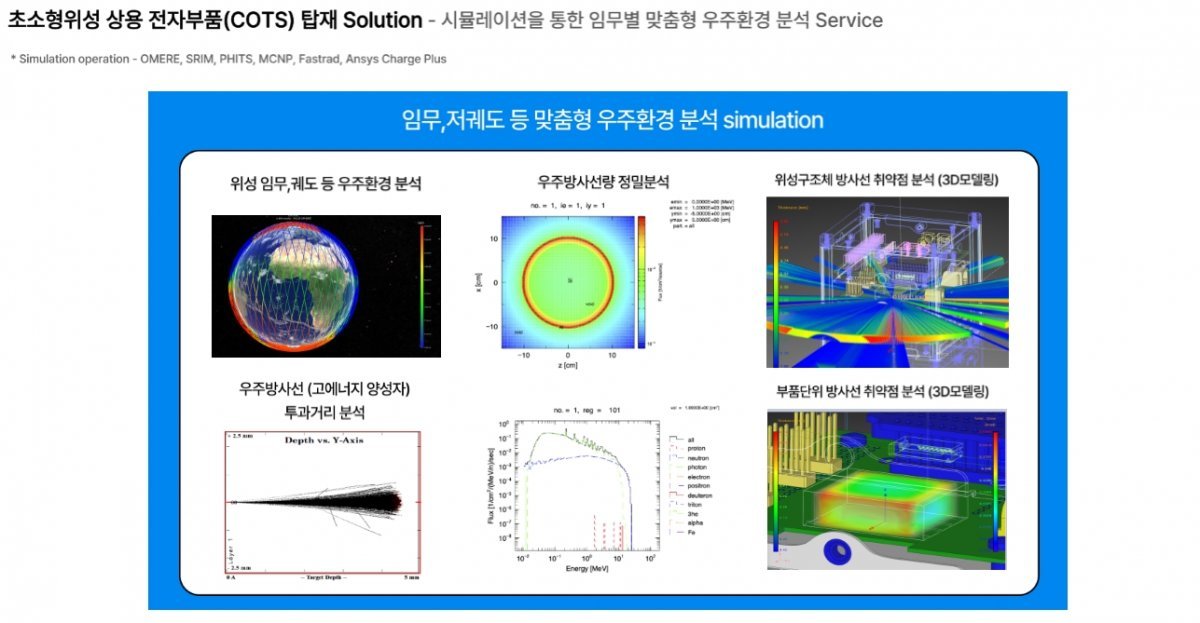
Space&Bean is a company working to extend the lifespans of small satellites. To help anticipate and prepare for the space environment—especially space radiation, the main cause of satellite failures—it has developed a “COTS integration solution for small satellites (a mission-specific space-environment analysis service via simulation),” and it is producing radiation-shielded housings and CubeSats.
Min Kyung-ryeong, CEO of Space&Bean (hereafter “Min”), said, “The strength of small satellites is cost-effectiveness compared with medium-to-large satellites. They must be built ‘more’ and ‘lighter.’ Even if we design and develop them with short mission lives in mind, we still face the task of reducing the high 58% failure rate within the first year. If we can improve short lifespans, we should. Medium-to-large satellites use space-grade electronic components to achieve ten-year mission lives, but those are expensive and do not offer great performance. If we replace them with commercial off-the-shelf (COTS) components, we can achieve high performance at low cost.”
In practice, overseas satellite manufacturers are increasingly using COTS components depending on mission and functional requirements. Put simply, it is akin to replacing a costly, heavy, bulky space-grade CPU with Pentium-class performance with a commercial CPU of the sort commonly used in high-performance PCs. If COTS components can be used in space environments—such as under space radiation—the cost of building satellites like small satellites can be lowered and development timelines drastically shortened.
Min added, “Our first priority is to introduce a simulation within the year. It will analyze and provide required performance matched to the satellite’s payload, operational orbit, and shielding requirements. Radiation types vary by orbital altitude, so the types and stacking order of shielding materials must be adapted. Because radiation levels differ by altitude, shielding performance (and weight) must also be tailored to the satellite’s operational altitude.”
“In line with this plan, we will analyze the absorbed dose by shielding material and provide solutions that enable the use of COTS components,” Min said.
To support these plans, Space&Bean has established a product-performance validation process. It offers semiconductor radiation-assessment methodologies, semiconductor failure-rate analysis, and semiconductor structural analysis, and—by working with accredited space-grade semiconductor test institutions and experts—conducts soft-error testing, reliability testing, and structural analysis. Based on the shielding materials and stacking methods derived from simulation results, the company will also manufacture and supply products that provide optimal shielding.
──────────────
지난 2024년 5월 7일, 과학기술정보통신부(이하 과기정통부)와 한국항공우주연구원(이하 항우연)이 오는 24일까지 누리호 4차 발사에 탑재할 부탑재위성 6기에 대한 공모를 진행한다고 발표했다. 내년 하반기(2025년 11월 예정)에 발사할 예정인 누리호 4호의 주탑재위성은 ‘차세대중형위성 3호’다. 주탑재위성과 함께 공공활용 및 국내 산업체 기술역량 제고를 위해 위성개발 역량을 보유한 국내 산업체 및 연구기관을 대상으로 부탑재위성을 공모한다.
부탑재위성은 약 3주간의 공모 기간 동안 위성 및 발사체 분야 전문가로 구성된 평가위원단이 ‘임무 및 개발 계획’, ‘공모 기관의 위성 개발 역량’, ‘품질 및 안전성’ 등을 종합 평가해 선정할 예정이다. 부탑재위성 선정 규모는 국내 기업 및 연구기관 개발한 초소형급 큐브(Cube) 위성 6기(6U 3기, 3U 3기 예정)이며, 공공 활용 목적의 임무를 갖출 경우 발사 비용을 면제 받을 수 있다.
지난 2023년 5월, 누리호 3차 발사 당시에는 주탑재위성으로 차세대소형위성 2호를 탑재하고, 부탑재위성으로 공모를 통해 한국천문연구원의 도요샛, 루미르의 LUMIR-T1, 카이로스페이스의 KSAT3U, 져스텍의 JAC 등 총 7기를 선정해 탑재하고 발사한 바 있다.
누리호 4차 발사 부탑재공모 발표와 함께 이창선 과기정통부 거대공공연구정책관은 “누리호 발사 동반 탑재는 국내 산업체와 연구기관에게 있어 초소형 큐브위성 플랫폼의 우주기술 검증과 헤리티지 확보를 위한 좋은 기회가 될 것”이라며 “누리호 부탑재위성 발굴을 통해 국내 우주항공 분야 산·학·연 주체의 기술경쟁력 강화 및 판로 개척에 기여하는 든든한 플랫폼을 제공할 것”이라고 말했다.
뉴스페이스 시대가 다가온다
뉴스페이스(New Space)는 민간 기업이 우주 개발을 주도하는 시대를 일컫는다. 과거 정부 주도로 우주를 개발한 시대를 '올드 스페이스(Old Space)'라고 부르는 것에 대비되는 개념이다. 우주 개발은 막대한 투자 비용 대비 낮은 경제성으로 인해 주로 정부 주도 하에 군사적 목적이나 과학적 탐구를 목적으로 진행했다. 정부가 국가 예산을 바탕으로 우주 개발하고 민간 대형 업체가 관련 프로젝트에 참여하는 방식이 주였다.
하지만, 인공지능, 사물인터넷, 3D 프린터 등의 4차산업혁명과 우주 개발 경험이 융합되며 민간 기업들도 우주 산업 개발 영역에 진출, 새로운 기회를 창출하고 있다. 원격감지, 해상 내비게이션, 지구 관측, 재난 관리 서비스 등에 활용할 수 있는 관측 서비스, 대형위성의 단점을 보완한 위성정보와 저지연 초고속 통신 환경을 구현하는 통신 서비스 등이 대표적이다.
뉴스페이스의 주도적 역할을 해온 기업 중의 하나가 스페이스X다. 스페이스X는 재활용할 수 있는 우주발사체를 개발해 이전보다 저렴한 비용의 위성 탑재 및 발사 서비스를 제공하고 있으며, 저궤도 군집 인공위성을 이용한 ‘스타링크’ 통신 사업을 제공한다. 지난 2019년부터 스타링크 위성을 쏘아 올린 스페이스X는 현재 저궤도에 약 5500기의 위성을 배치했고, 오는 2027년까지 1만 2000기까지 늘릴 계획이다. 2023년말 기준 세계 60국 200만 명이 스타링크 위성 통신 서비스를 사용하고 있다.
우리나라도 뉴스페이스에 대비하고 있다. 지난 2024년 4월 24일, 국내 첫 양산형 초소형 군집위성 ‘네온셋 1호’ 발사에 성공했으며, 오는 2027년까지 10기를 추가 발사해 11기를 동시에 운용할 계획이다. 초소형위성 11기를 연결해 활용하는 군집위성은 각각의 초소형 위성이 서로 보완하며 동일한 임무를 수행할 수 있도록 돕는다. 마치 전투기가 편대비행을 하며 작전을 수행하는 것과 같다. 군집 위성을 모두 확보하면 하루 3번 이상 준 실시간 수준으로 한반도 전역을 관측할 수 있다.
누리호 발사 성공 이후 정부는 민간 우주산업을 키우기 위해 노력 중이다. 민간이 주도하는 우주 개발, 뉴스페이스 생태계 활성화다. 초소형위성 발사 및 탑재 기회를 꾸준히 제공하는 이유다.
초소형위성으로 열리는 뉴스페이스 시대
일반적으로 무게 100kg 이하의 위성을 초소형위성이라고 말하며, 가로·세로·높이 10cm의 육면체에 질량 1.3kg 수준의 초소형위성을 큐브위성(큐브샛, Cubesat)으로 구분한다. 비교적 정형화된 형태로 제작되는 큐브위성은 1U(Unit), 2U, 3U 크기와 질량 등을 규격화하고 있다. 이러한 규격화 이후 스타트업 등 민간기업의 참여는 활발해졌다.
특히, 초소형위성의 가장 큰 장점은 비용이다. 중대형위성과 비교해 개발 기간도 짧고 개발 비용도 싸다. 스타트업과 같은 민간 기업이 우주 위성 제작 및 개발에 참여하는 이유 중 하나다. 예전처럼 위성을 반드시 다목적으로 무겁고 크게 만들 필요가 없어진 만큼, 다양한 서비스 수요에 대응하는 초소형위성, 큐브위성을 제작할 수 있다.
다만, 큐브위성의 수명은 비교적 짧다. 10년 정도의 임무 수명으로 제작하는 다목적 중대형위성과 비교해 초소형위성의 임무 수명은 3년 정도에 불과하다. 1년 이내 고장율은 58%에 달한다. 고장나면 빠르게 제작해 다시 발사할 수 있지만, 낮은 임무 수명은 개선할 필요가 있다.
초소형위성의 높은 고장율 발생 환경 1위는 우주방사선 때문이다. 우주방사선(64%), 원인불명(21%), 태양풍(8%), 자기폭풍(3%), 유성(2%), 일식(2%) 순이다(A Study of on-orbit spacecraft failures, Siamak Tafazoli, 2009). 우주방사선 때문에 위성의 전자장비(45%), 구조체(32%) 등이 고장나는 경우가 대부분이다. 우주방사선이 위성에 미치는 영향은 반도체 누적 손상(성능 저하), 하나의 고에너지 중이온이 반도체를 관통하면서 내부 원소들의 위치가 변화해 발행하는 오류(원소 위치 변화), 우주방사선이 전자부품에 침투해 회로에 펄스 신호를 발생시키는 현상(순간 오류) 등이 있다.
초소형위성 임무 수명을 늘릴 수 있다
스페이스앤빈은 초소형위성의 수명을 늘리기 위해 노력하고 있는 기업이다. 위성의 주 고장원인인 우주방사선과 같은 우주 환경을 미리 분석해 대비할 수 있도록 ‘초소형위성 상용 전자부품(코츠, COTS) 탑재 솔루션(시뮬레이션을 통한 임무별 맞춤형 우주환경 분석 서비스)’을 개발했으며, 우주방사선을 차폐할 수 있는 차폐 하우징과 큐브위성을 제작하고 있다.
민경령 스페이스앤빈 대표(이하 민 대표)는 “초소형위성은 기존 중대형위성 대비 저렴한 가성비가 강점이다. ‘더 많이, 더 가볍게’ 제작해야 한다. 짧은 임무 수명을 감안해 제작하고 개발하더라도 1년 내 58%라는 높은 고장율은 낮춰야 하는 숙제다. 사실 짧은 수명도 개선할 수 있다면 고쳐야 하지 않겠나”라며, “중대형위성은 10년이라는 임무 수명을 갖추기 위해 우주급 전자부품을 사용하지만, 그만큼 비싸다. 성능도 좋지 않다. 이를 상용 전자부품으로 대체한다면, 저비용에 고성능을 갖출 수 있다”라고 말한다.
실제로 해외 위성 개발사의 경우 위성의 임무 및 요구 기능에 따라 상용 전자부품을 활용하는 사례는 계속 늘어나고 있다. 쉽게 말해, 비싸고 무거우며 부피가 큰 펜티엄급 성능의 우주급 CPU를 일반적으로 사용하는 고성능 PC의 상용 CPU로 대체하는 일이다. 이처럼 상용 전자부품을 우주방사선 등 우주 환경에 활용할 수 있다면, 초소형위성과 같은 위성의 제작 비용을 낮추고 개발 기간도 획기적으로 줄일 수 있다.
민 대표는 “우선적으로 연내 시뮬레이션을 선보인다. 위성 탑재장비, 운용궤도, 차폐 요구도에 맞춰 요구 성능을 분석해 제공하는 시뮬레이션이다. 위성 운용 고도별 방사선은 종류가 다르다. 때문에 차폐 소재의 종류와 차폐 순서를 다르게 사용해야 한다. 고도별 방사선량이 다르므로 위성 운용종류(고도)별로 차폐 성능(무게)를 다르게 해야 한다”라며, “차폐 소재별 방사선 흡수선량을 분석하고, 상용 전자부품을 활용할 수 있는 솔루션을 제공할 계획이다”라고 설명했다.
이 같은 계획에 맞춰 스페이스앤빈은 제품성능 입증 프로세스를 갖췄다. 반도체 방사선 평가 방법, 반도체 고장율 분석, 반도체 구조 분석 등을 제공하고, 우주급 반도체 시험인증기관과 전문가를 활용해 오류율 시험, 신뢰성 시험, 구조 분석 등을 제공한다. 시뮬레이션 결과 도출한 차폐 소재와 적층 방법에 따라 최적의 차폐를 위한 제품도 제작해 제공할 예정이다.